


A pump that can run in both directions sounds like a shortcut to simpler piping. Fewer valves, fewer connections, and the ability to empty a tank into either of two destinations without rearranging the line. In practice, bidirectional operation is a design feature that works brilliantly in some scenarios and causes rapid wear in others.
The difference comes down to how the pump moves fluid. Positive displacement designs that use flexible vanes present a unique set of trade-offs when flow reversal is required. This article examines where reverse operation adds real value, where it creates problems, and how to evaluate whether a given pump is built for it.
Where Reverse Flow Adds Value
The most common use case for bidirectional pumping is tank transfer operations. A single pump positioned between two vessels can fill Tank A from Tank B, then reverse to return the contents or transfer to a third vessel. This eliminates the need for a second pump or a complex manifold of diverter valves.
In clean-in-place systems, reverse flow serves a different purpose. Running a CIP solution backwards through a pump can help clear product residue from the impeller cavity and seal areas that forward flow might not reach effectively. This capability is particularly useful when the pump handles viscous or particulate-laden products that tend to accumulate in low-velocity zones.
A third application is pipeline clearing. After a production run, reversing the pump can pull product back from the discharge line, reducing waste and simplifying the cleaning sequence. For high-value products such as pharmaceutical intermediates or specialty food ingredients, this recovery step alone can justify the added complexity of a bidirectional setup.
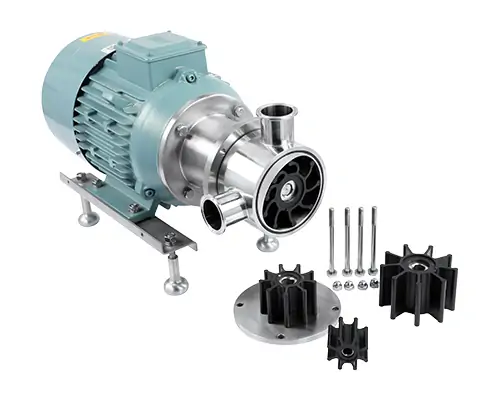
When evaluating equipment for these applications, a flexible impeller pump with a symmetrical impeller design generally handles bidirectional flow better than one with directional blades optimized for a single rotation. The symmetrical vane profile allows the tips to engage the cam in either direction without folding or excessive stress.
What Happens Inside When Flow Reverses
Understanding why reversal matters requires a quick look at the pumping mechanism. In a vane-type positive displacement design, a rotor with elastomeric blades spins inside a housing. An eccentric cam compresses the blades on one side of the rotation, creating the volume change that moves fluid. When the pump reverses, the blades must flex against the cam from the opposite direction.
This reversal changes the mechanical loading on every component. The impeller tips, which are designed to sweep across the cam in one direction, now approach from a different angle. The shaft seal, typically optimized for a dominant pressure side, may see pressure on the opposite face. The bearing set, which may have a thrust bearing sized for one direction, now absorbs force in reverse.
For pumps engineered specifically for bidirectional service, these challenges are addressed at the design stage. Symmetrical cam profiles, reinforced blade roots, and dual-direction mechanical seals are common features. For pumps designed primarily for single-direction operation, even occasional reversal can accelerate impeller wear and shorten seal life.
When Reversing a Standard Pump Goes Wrong
Not every sanitary pump is built for bidirectional operation, and running one in reverse without confirming its design limits can lead to premature failure. The most common failure modes include impeller tip tearing, where blades designed for unidirectional flex crack at the root when forced backward against the cam. Shaft seal leakage can occur when the seal face, lapped flat for one pressure direction, lifts slightly under reverse pressure. Thrust bearing overload may happen when the axial load reverses and the bearing set lacks capacity in that direction. Motor issues can also arise—while most three-phase motors reverse easily by swapping two leads, single-phase motors may require specific windings for reverse operation.
The critical check before implementing reverse flow is to confirm the manufacturer's stated capabilities. A pump rated for bidirectional service will have documentation specifying maximum reverse speed, allowable differential pressure in reverse, and any derating factors compared to forward operation.
Application-Specific Considerations
Different industries place different demands on reverse-flow pumping. In wine and juice production, gentle handling matters more than pressure capability. Reversing a sanitary vane pump to recover product from lines prevents valuable liquid from going to drain. The low shear characteristics of these pumps mean the product quality is preserved even during the reverse cycle.
In dairy processing, CIP effectiveness drives the interest in reverse flow. Running cleaning solution backwards through the pump housing ensures that spray devices, heat exchangers, and fillers receive adequate flow regardless of piping configuration. Here, the pump must handle hot caustic and acid solutions at temperatures that challenge elastomer stability, regardless of flow direction.
In pharmaceutical and biotech applications, the priority is often containment. A bidirectional pump that can strip a transfer line of high-value product before the line is opened reduces both product loss and operator exposure risk. The validation documentation required in these industries means the pump manufacturer must provide test data confirming performance in both directions.
Evaluating a Pump for Bidirectional Service
When assessing whether a pump can handle reverse flow, a short checklist helps structure the evaluation. First, request the manufacturer's written confirmation of bidirectional capability, not verbal assurance from a sales representative. Second, verify impeller material compatibility with reverse operation—some elastomers, particularly natural rubber and certain EPDM compounds, are more prone to fatigue cracking when flexed bidirectionally. Third, confirm seal type and pressure rating in reverse; a balanced mechanical seal rated for vacuum service is a good indicator of bidirectional capability. Fourth, check motor suitability for reverse rotation, including any necessary winding configurations or drive protections. Finally, test under controlled conditions with a non-critical fluid before committing to production service.
Before selecting a reversible sanitary pump, it is worth reviewing detailed specifications that cover impeller material options and maximum reverse differential pressure ratings. These data points often reveal whether the pump was truly designed for bidirectional service or simply tolerates it.
When a Valve Is the Better Answer
There are situations where using a pump in reverse creates more risk than it solves. If the reverse flow requirement is infrequent—say, once per week for a line clearing operation—installing a simple diverter valve arrangement may be more reliable and cost-effective than specifying a bidirectional pump and accepting the associated maintenance implications.
If the system requires different flow rates in each direction, a single bidirectional pump may not optimize both operating points. A pair of dedicated pumps, each sized for its specific duty, can deliver better efficiency. And if the reverse flow path exposes the pump to abrasive or corrosive conditions that differ significantly from the forward path, seal and impeller degradation may accelerate. In these cases, redirecting flow through external piping rather than reversing the pump is often the more conservative choice.
Making the Decision
Reverse flow capability is a tool, not a universal advantage. It simplifies piping, reduces component count, and can improve product recovery in specific applications. It also introduces mechanical complexity that must be understood and managed.
The decision ultimately depends on a clear-eyed assessment of the operating context—what the pump moves, how often direction changes, and what a failure would cost in downtime or product loss. By matching the pump's design to the real demands of the process, rather than assuming all sanitary pumps can run both ways, operators gain reliability without unnecessary risk. Reviewing the specifications of a flexible impeller pump with these factors in mind helps ensure the equipment selection aligns with how it will actually be used.